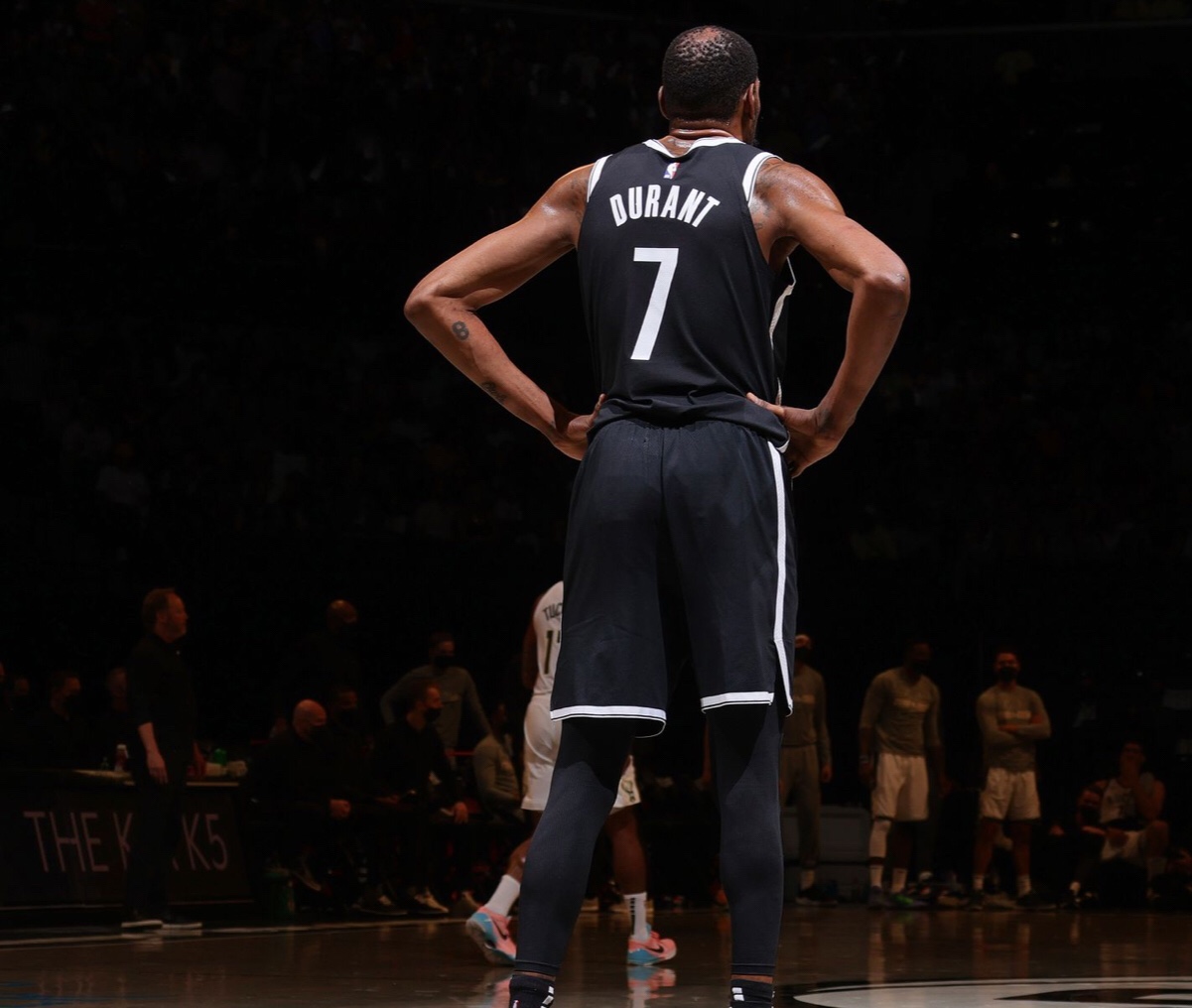
Six years ago you were a cupcake. Shortly after that, you were a snake. And now to add to the list, you are a FRAUD Kevin Durant!!
Does that sum up what we’ve heard the past couple of days? Two of the biggest media personalities in the world, Stephen A. Smith and Skip Bayless, have given Durant the elusive title of the best player in the world. But the supposedly “best player in the world” doesn’t ever go down like this. They don’t get swept out of the first round while also playing alongside another all-star player, and they don’t lose while averaging 26.3 points per game on 38.6% shooting.
The NBA world has every right to go after KD the way they have. They did it to Magic Johnson after his late-game blunders in the 1984 Finals. They did it to Michael Jordan after he lost to the Detroit Pistons for the third year in a row. They did it to Kobe Bryant after the 2004 Finals when he shot the Lakers out of the series. They did it to LeBron James after the 2011 Finals when he became the “Frozen One”. And they did it to Stephen Curry after the 2016 Finals when the best regular-season team of all time blew a 3-1 lead in the Finals. When a player of his caliber underachieves in a major way in the playoffs, they get eaten alive by the NBA world. It’s how it’s always been.
When we look back at Kevin Durant’s career when he decides to call it quits, this will now be the first thing that we will point to when we talk about the negative aspects of his career. It’s what his detractors will use to pushback on where he should be ranked among the all-time greats. The question that we want to ask is how big of a deal is getting swept out of the first round? Do we push back on it to the other retired legends of the game? These questions will help us know if we’re just trolling or if it’s a legitimate cause of concern.
I’m going to only be looking back at the top 30 players of all-time according to “The All-Time Greatest NBA Book”. And there have been a few times where it has happened to some of these legendary players that were playing during their prime years. Here is the list below:
Michael Jordan
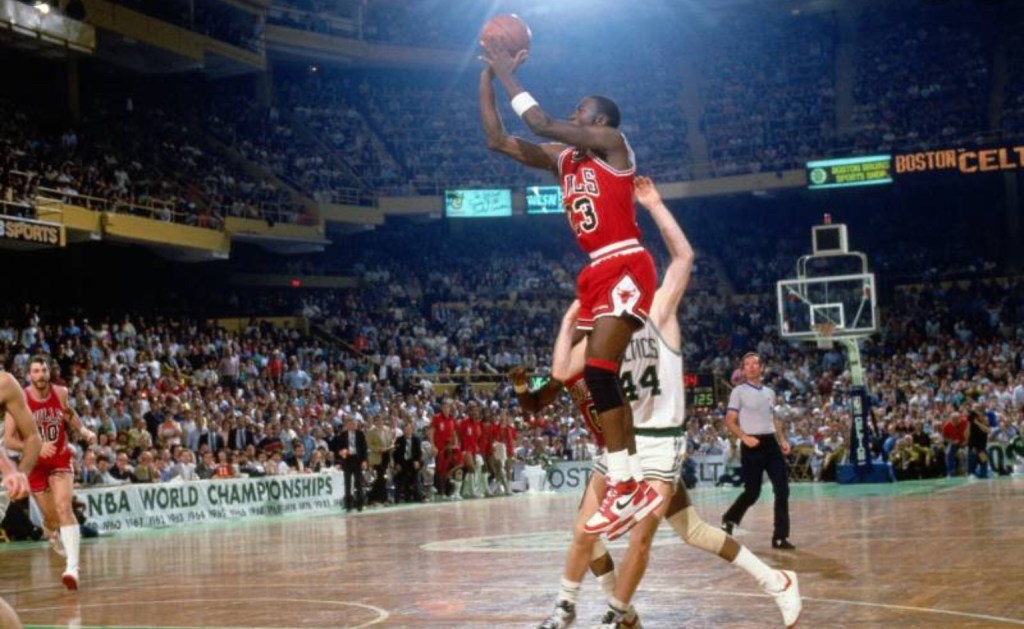
That’s right. The greatest player of all time has been swept out of the first round during his career. But if anyone should get a pass for this… of course it should be Michael Jordan. This occurred in 1986 against the team that is widely considered as one of the greatest of all time. To illustrate how lopsided of a duel this was, the Boston Celtics finished the season with a 67-15 record compared to the 30 wins that the Bulls ended with. We’re talking 37 more victories that the Celtics had over the Bulls. It should be noted that Michael Jordan played 18 games that season, and was restricted to playing only 25 minutes per game when he came back late in the season.
Even with the odds stacked against the Bulls, Michael Jordan was single-handedly able to keep the series interesting. He scored 49 points in the first game of the series, and then he goes off with the greatest scoring performance in NBA playoff history in the following game. He ended up scoring 63 points on 53.7% shooting. After the game was over, Larry Bird famously said that he was “God disguised as Michael Jordan”. Was Jordan able to carry his team to a victory? No, he wasn’t. But when you’re getting compared to a deity by one of the greatest players of all time then I think it’s only fair that we give him a pass for not being able to win a game against one of the greatest teams ever. Especially when you end up averaging over 43 points per game for the series.
However, that wasn’t the only time that Jordan got swept from the first round. The Chicago Bulls faced the Celtics in the following year, and the Bulls were unable to pull out a victory in the playoffs for the second year in a row. Jordan was not as spectacular, and he averaged for the series 35.7 PPG on 41.7% shooting. So why do we never hold this against him? The reason is that the Boston Celtics had a total of five hall of fame players on their roster, while Michael Jordan was the only player for the Bulls to make multiple all-star appearances in their career. Charles Oakley made the all-star in 1994. So when a team employing Bird/McHale/Parish/Dennis Johnson/Walton is playing a team employing Jordan/Oakley/John Paxson/Gene Banks/Dave Corzine, then it shouldn’t be held against a player playing in his second and third year to beat a team stacked with championship experienced players. So I believe Kevin Durant’s recent performance can’t compare to what Michael Jordan did early in his career.
Michael Jordan 1986 1st round series: 43.7 PPG (50.5%), 6.3 RPG, 5.7 APG, 2.3 SPG, 1.3 BPG, 4.7 TOV
1987 1st round series: 35.7 PPG (41.7%), 7 RPG, 6 APG, 2.3 BPG, 2.0 SPG, 2.7 TOV
Hakeem Olajuwon
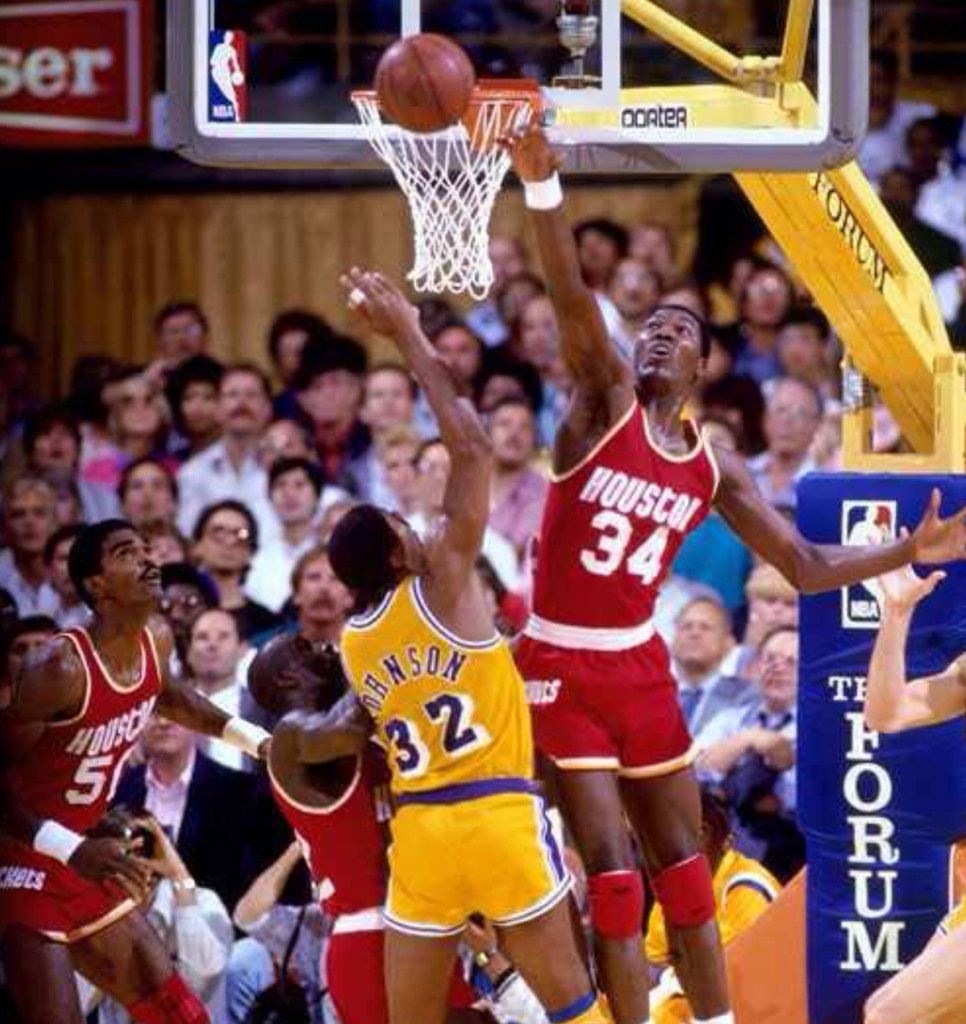
The Houston Rockets got swept by the Los Angeles Lakers in the 1991 first-round series. The Lakers were the 3rd seed that season, and it was predicted prior to the start of the playoffs that the Rockets would give the Lakers a little bit of trouble. The Lakers did not have a strong frontline, and many of the NBA experts were predicting that Hakeem would post big numbers against LA. But this was not the same team that dominated the 80s. The Lakers no longer had Kareem and they no longer had Pat Riley running the show. Mike Dunleavy completely redid Los Angeles’s offense and defense, and this was a team that was going to beat you with their defense. The Lakers ranked 2nd in opponents points per game, and they ranked 5th in defensive rating that season. They also ended up with the 3rd slowest pace in the league, which indicates that the Lakers utilized the half-court offense heavily that year.
Just as the Celtics did not allow Kevin Durant to ever go off during the series, the Lakers swarmed Hakeem and did not allow him to get anything going on offense. Credit goes to Vlade Divac who (with help) all but played Hakeem Olajuwon to a standstill. The Rockets’ running game was stalled, and the Lakers forced them to become a jump-shooting team. Shooting was not an aspect that teams in the early 90s prevailed at, and that was certainly the case with the Houston Rockets. The Lakers executed their defensive game plan to perfection. Hakeem averaged a measly 22 points per game on 57.8% shooting for the series. He was even outscored by Magic Johnson, who averaged 22.7 points per game for the series. So this player, who in the eyes of some is a top 10 player of all-time, got swept out of the first round while having a rather pedestrian performance in the playoffs.
Hakeem Olajuwon 1991 1st round series: 22.0 PPG (57.8%), 14.7 RPG, 2.7 BPG, 2.0 APG, 2.7 TOV
Dirk Nowitzki
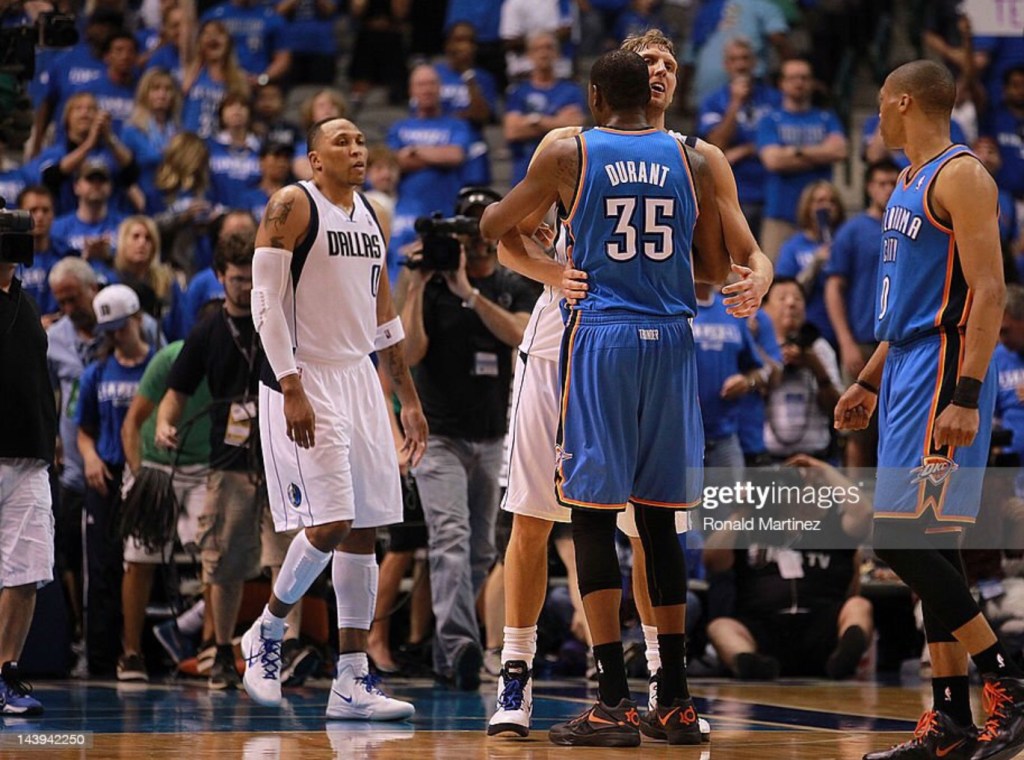
The Dallas Mavericks went from winning the championship to getting swept out of the first round in the following year. The OKC Thunder were able to exact revenge on the Mavs from their gentleman’s sweep the previous year in the conference finals, but this series was closer than people remember. In fact, three of the four games from that series were winnable games for Dirk and the Mavs. They led in the final minute of both games in Oklahoma City but couldn’t even manage a split as the Thunder gutted out two wins by a total of four points. Dirk even admitted to reporters, “We’re just a couple bounces away from being up 2-0”.
Kevin Durant was the hero in game 1 after he received a friendly roll from his game-winning jumper from 15 feet out. Then in game 4, the Mavs held a 13-point lead going into the fourth quarter. At that point, they were just playing for pride and they did not want to follow up their championship season with a first-round sweep. However, the Thunder outscored the Mavs 35 to 16 behind a big fourth quarter from James Harden. He scored 15 points on 6/9 shooting and dished out 3 assists. On the other hand, Dirk Nowitzki wasn’t able to continue his hot shooting, and he went ice-cold during the fourth quarter. He went 1/8 from the field in the final period.
The problem the Mavericks were having was that they didn’t have anyone other than Dirk Nowitzki capable of consistently scoring. They lost some key pieces from their championship team that became a big factor on the struggles they were experiencing during the season. They traded away Tyson Chandler, who was the defensive anchor for this team. In fact, he ended up winning the DPOY award with the New York Knicks in the same year he got traded away. Peja Stojaković retired before the season began, J.J. Barea signed with the Minnesota Timberwolves in the offseason, and DeShawn Stevenson got traded away to the New Jersey Nets. So they lost a lot of their younger talent, and the Mavs just seemed too slow and too old by the time the playoffs began. That was even more apparent when they played the young and hungry OKC Thunder. By the time the series was over, the defeat had more to do with an aging Mavs’ team with eight players in their 30s fading when it mattered most because keeping up with the youngsters for three quarters required so much energy.
I understand that Dirk was 33 years old by the time the playoffs began, so this particular failure had a lot to do with age and fatigue. But the fact that he gave us one of the greatest playoff runs in the history of the game in the previous year makes me less inclined to give him a pass. And one last thing… do you know how old Kevin Durant is now? He’s 33 years old. So if we’re not going to make age an excuse for KD, then we shouldn’t for Dirk.
Dirk Nowitzki 2012 1st round series: 26.8 PPG (44.2%), 6.3 RPG, 1.8 APG, 2.5 TOV
Karl Malone & John Stockton
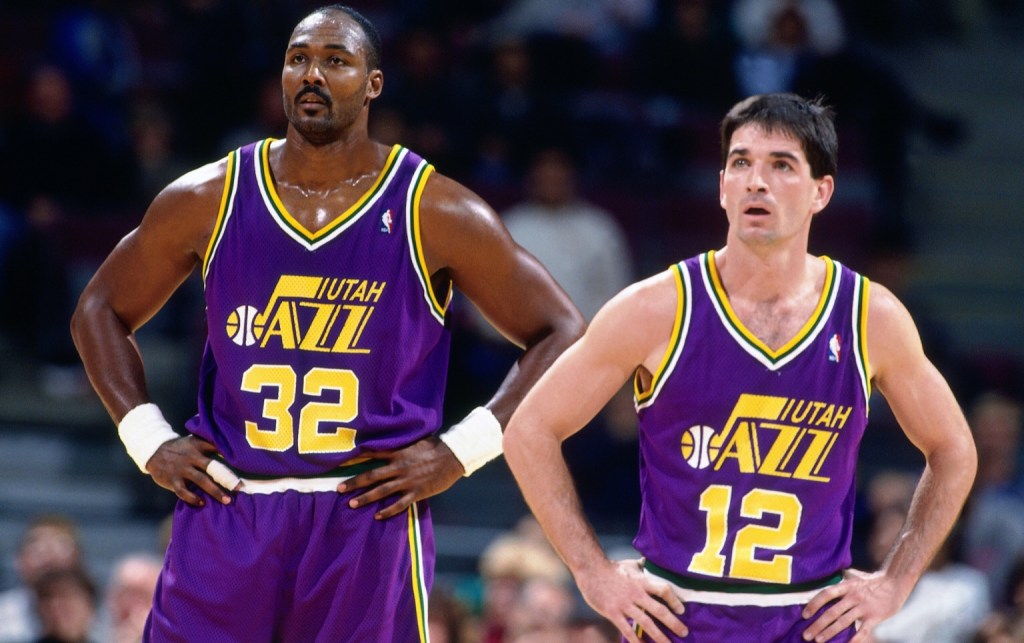
Don Nelson, the coach of the Golden State Warriors, described his team’s three-game playoff sweep of the heavily favored Utah Jazz as a “miracle.” Chris Mullin called it “beautiful.” That is according to the Washington Post from 1989. Needless to say that the NBA world was shocked after the Warriors crushed the Utah Jazz that was supposed to take the mantle from the Showtime Lakers as the new powerhouse of the Western Conference. This was the same team that pushed the eventual champions to 7 games in their semifinals matchup in the previous year. So when the Jazz finished the 1989 season with the second-best record in the West, the NBA world was expecting an epic rematch between these two teams in the conference finals. The Golden State Warriors were supposed to be easy prey for this young and up-and-coming team.
Don Nelson had other plans. He doesn’t get enough credit for this, but Donnie was a visionary. The Warriors played a certain style that is prominent in today’s NBA. He proposed to play small, looking to isolate a quick player against a mismatched defender in open-court situations. The plan was to simply outscore you on offense. Then on defense, the Warriors pressured the Jazz by swarming them with three long and athletic forwards that were playing in their starting rotation. At 6’7″, Chris Mullin brought big-guard skills to the small forward position. Rookie of the Year Mitch Richmond played a big 6’5″ at the shooting guard position, and Rod Higgins was a quick 6’7″ forward. Their center was Larry Smith, who at 6’8” was tenacious at the boards. The Warriors prevailed with this lineup, and they won game 1 with the score being 123-119. Chris Mullin led the way with 41 points and Mitch Richmond scored 30 points.
The next game is where Karl Malone, and especially John Stockton get some heat. Karl Malone started out punishing the smaller Warriors for three quarters, who had 37 points going into the final period. But then all of a sudden, the Jazz went ice cold from the field. This is how Sports Illustrated described what occurred in that final quarter, “Late in the third quarter. Golden State threw a 1-3-1 trap at Utah, a defensive configuration that pinches a forward with two, sometimes three, defenders. ‘You know what a sardine feels like?’ asked Malone—who went scoreless in the final quarter—after the game. ‘That’s what it felt like.’ The Jazz failed to convert 18 of its first 21 shots in the last quarter. During that span, Stockton missed eight straight shots, including six consecutive open jumpers.”
The Warriors did a tremendous job with moving the defense all over Malone and making it difficult for him to receive the ball. It was up to Stockton to make some easy open jumpers that he was accustomed to hitting for his whole career, but he choose the worst time to get cold. It was something that unfortunately happened to him too often in critical playoff games. A lot of the credit also deserves to go to the 7’7” Manute Bol, who totally frustrated Malone. He averaged an impressive 6 blocks per game for the series, and he did not make things easy for Malone with the clear size advantage he had.
The truth is that Karl Malone and John Stockton put up decent numbers for this series. That is something that they have over Kevin Durant and Kyrie Irving, who both struggled from the field during the series against Boston. But one thing they do have in common with the Nets’ duo is that they did a poor job in closing out games in their first-round sweep. That was one of the main reasons why this legendary duo was on the wrong side of one of the biggest upsets in playoff history.
Karl Malone 1989 1st round series: 30.7 PPG (50%), 16.3 RPG, 4.3 TOV, 1.3 APG
John Stockton 1989 1st round series: 27.3 PPG (50.8%), 13.7 APG, 3.7 SPG, 3.3 APG, 1.7 BPG, 3.6 TOV
Kevin Garnett
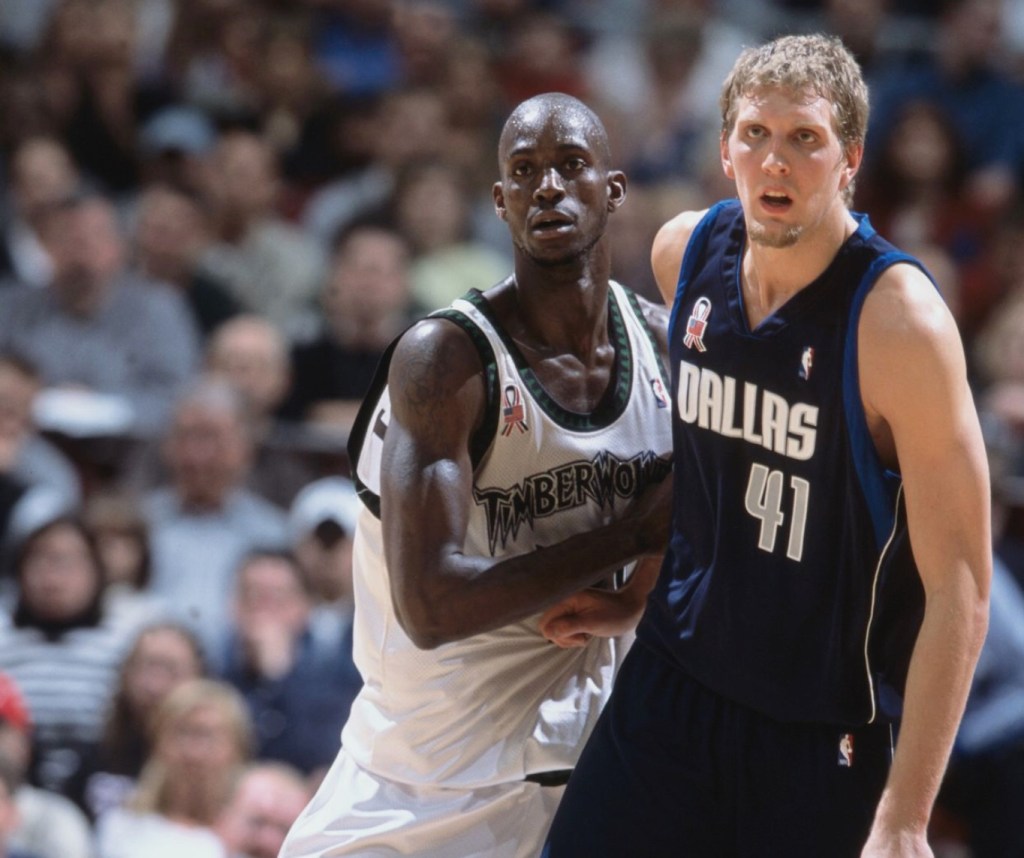
KG was starting to feel the pressure of leading his team passed the first round after 5 straight years of failing to advance to the semifinals. So when he got swept in the first round in 2002, we were starting to question the greatness of Garnett. The Minnesota Timberwolves went into the playoffs as the 5th seed, and we had reasons to believe that the Wolves would be able to make some kind of run in the 2002 playoffs. They ended the season with 50 wins, and the Wolves were finally able to add some decent pieces around Garnett. Wally Szczerbiak made his first and only all-star appearance that season and Chauncey Billups was starting to show signs of the player he would end up becoming. But as the saying goes in the NBA, the playoffs are all about matchups. And the Dallas Mavericks were the team that the Wolves did not match up well with at all.
It seemed like the Mavs were daring the Wolves to try to outscore them, and the Wolves had no chance of keeping up with their high-power offense. The Mavericks, led by Dirk and Steve Nash, ended the season with the highest points per game average and the highest offensive rating in the league. You can’t beat a team like that if you don’t have a dominant scorer on your roster. It also didn’t help matters that Terrell Brandon suffered a serious leg injury before the all-star break that caused him to miss the rest of the season. Without him on the lineup, the Wolves just didn’t look competent against the Mavs. There wasn’t nearly enough ball movement, and the players just seemed too skittish.
But the reality is that the NBA world was coming to realize that Kevin Garnett was not a very reliable go-to scorer that the Wolves needed to advance. KG was a lot of things, and he excelled in a lot of different areas of the game. That includes scoring, but he wasn’t the guy that was going to give you 30 points a night and take over on the offensive end. The Dallas Mavericks had that, and Dirk Nowitzki clearly outplayed Garnett in that series. Dirk averaged 33 PPG on 52.6% shooting, 15.7 RPG, and 3 SPG. The Mavericks were clearly the better team, but it doesn’t look good that Garnett wasn’t able to carry his team to at least one victory.
Kevin Garnett 2002 1st round series: 24 PPG (42.9%), 18.7 RPG, 5 APG, 1.7 BPG, 4 TOV
Charles Barkley
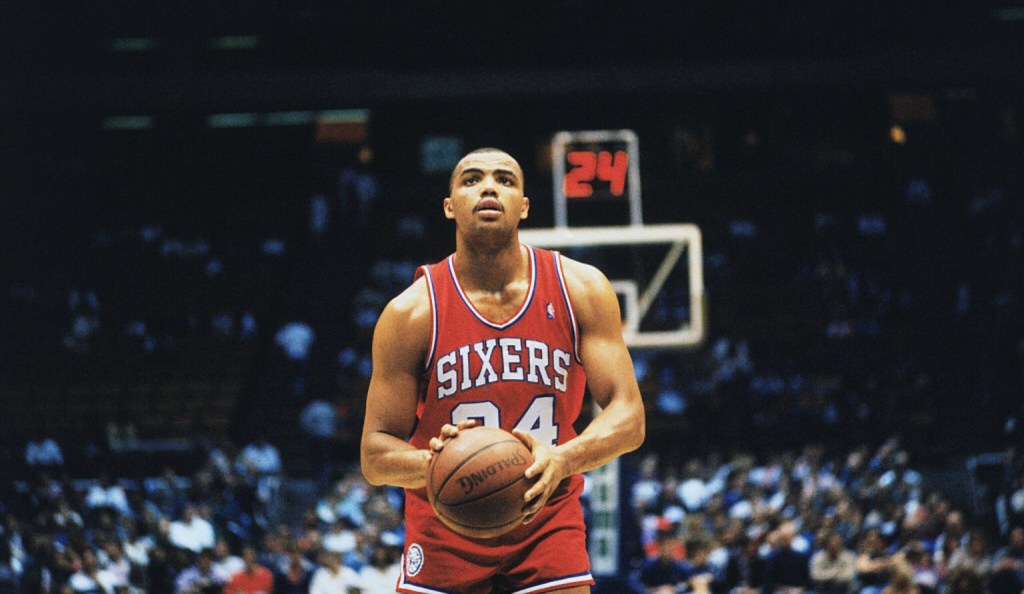
We have another interesting sideshow that’s going on with the first-round exit that Kevin Durant and the Nets have just experienced. Charles Barkley said on NBA TNT that, “To be on my Mount Rushmore, you have to be a bus driver, you have to be that key guy on your team. LeBron is on there because of that. Bill Russell is there because of that. Till KD wins one in Brooklyn, he won’t be a bus driver to me.” By no surprise at all, Kevin Durant then responded through social media by posting a picture of Charles Barkley’s time with the Houston Rockets. He then wrote, “Where would Chuck be without the big homies”. I think Kevin Durant was trying to point out the hypocrisy of his statement about his decision to play with the Golden State Warriors.
Charles Barkley made a similar move by signing with the Houston Rockets that had Hakeem Olajuwon and Clyde Drexler, and he also experienced a first-round sweep during his prime. That occurred in 1989 against the New York Knicks. The Sixers finished as the 7th seed in the Eastern Conference, which was a big improvement from the type of season they had the previous year. The Sixers were going through a rebuilding phase after the departure of Moses Malone and Dr. J, and the Sixers missed the playoffs because of it. But in the 1988-89 season, the Sixers improved by 10 wins behind the strong play of Charles Barkley. The New York Knicks were also a young and up-and-coming team. In the previous season, they barely made the playoffs by winning a total of 38 games. However, thanks to some key acquisitions that they made in the offseason by receiving Charles Oakley and Kiki Vandeweghe, the Knicks were able to improve by 16 wins.
So even though the Sixers were playing as the 7th seed, it was still expected to be a hard-fought series between these two young teams. Kind of like what we were expecting between the Nets and Celtics this year. However, the Knicks didn’t allow the Sixers to win a single game. The results indicate to us that the Knicks dominated the Sixers, but the reality is that it could have easily gone the other way around. Charles Barkley said this after game 3 according to the New York Times, “A break here and a break there, and we could have had a heck of a party. But they made the last shots when they counted and that’s all that matters.”
That was the key to this whole series, it was about which team was going to close out games better. The 76ers never could find a way to make those last shots, while the Knicks did make the ones that counted. Mark Jackson’s three-pointer with 16 seconds remaining clinched the opener. Trent Tucker’s three-pointer with 11 seconds left won the second game and an 18-footer by Gerald Wilkins with 6 seconds left in overtime was the series-clincher. The series was decided by a total of 8 points, which included a six-point victory in the opening game. Up to that point, there wasn’t a single series since the shot-clock was implemented where it was decided by fewer total points. Game 3 is a forgotten classic that I recommend all NBA fans to watch. There were so many huge baskets that were made during the final moments of the fourth quarter and overtime. That is including Charles Barkley making a jumper over Patrick Ewing to force overtime. However, before Gerald Wilkins made the series-clinching bucket, Gerald Henderson missed two free throws that would have extended their lead. As Barkley mentioned, the Sixers had their chances to make this a more competitive series, but they fell short.
Charles Barkley 1989 1st round series: 27 PPG (64.4%), 11.7 RPG, 5.3 APG, 3.6 TOV
Dwyane Wade
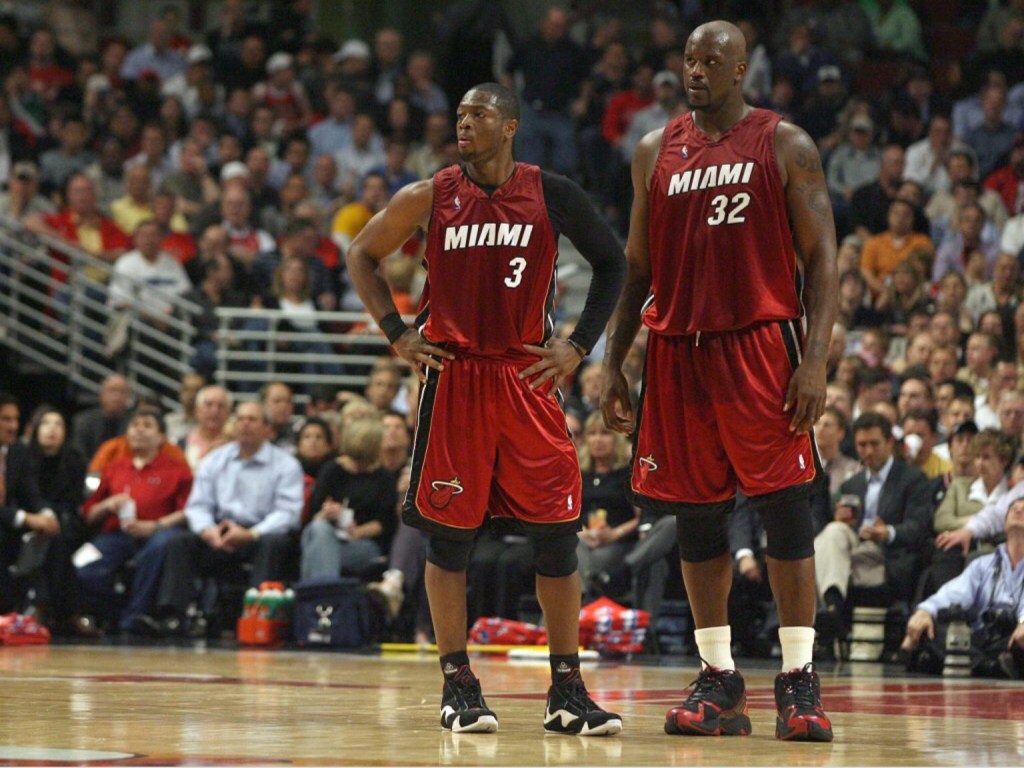
The Miami Heat were just coming off a title while posting the 4th least amount of wins (52 wins) to come from a championship-winning team since the merger. When they won the title, they had no one else other than Dwyane Wade to average over 14 points per game in the Finals. There was also a total of 7 players that were over the age of 30 that was playing more than 20 minutes per game going into the 2006-07 season. Maybe…. those are all warning signs that this team wasn’t exactly going to dominate the next season. Just maybe…. that’s an indication that you want to get younger. So how many free-agent signings did the Heat do after winning the title? Zero. It was a curious decision that confused a lot of NBA experts during the time, and it was no surprise that they struggled the way they did. Especially when Dwyane Wade missed 31 games during the season from injury due to the Iverson-like punishment he was receiving. So they went into the playoffs with a 44-38 record, and they finished as the 5th seed in the Eastern Conference.
But they had the championship experience, and they had Dwyane Wade. We’re talking about the same player that gave a Jordan-esque performance in the 2006 Finals. If he was good enough to beat the Dallas Mavericks by himself, then he was certainly good enough to take down the “Baby Bulls”. And if not for the series, he could do it for at least one game, right? That might have been wishful thinking since his first game back from injury came with 6 games left in the season. He did not look ready for playoff basketball, and he had trouble shooting the ball efficiently and taking care of the ball. He had two games where he posted 7 turnovers. And just like it was for the 2012 Dallas Mavericks, the Heat had no one good enough to pick up the scoring slack. So after completing the series sweep, the Bulls made NBA history by becoming the first team ever to knock off a defending champion in four games in the opening round of the playoffs. That would be the unofficial end of the Wade/Shaq era, and it would be the beginning of a disappointing four-year stretch for Wade and the Heat in the playoffs.
Dwyane Wade 2007 1st round series: 23.5 PPG (42.9%), 6.3 APG, 4.8 RPG, 5.8 TOV
The proof is in the pudding. This isn’t the first time that an all-time great player got swept from the first round while still in their prime years. I gave you 8 different examples from players who are somewhere in your top 30 players of all time. Some of these players posted respectable numbers, one player posted all-time great numbers, and there are a few that struggled. If we’re going to be honest here, we rarely bring up any of those shortcomings when discussing the legacy of these players. The only exceptions would be Dwyane Wade, and some fans who know the history of the game will bring up Hakeem’s 1991 playoff sweep. Will we do the same for KD 10 years from now when discussing his career, or will it be swept under the rug like some of the above examples? I think there’s no question that this will not be easily forgotten by the NBA world. Let’s compare now to how Kevin Durant performed in the first round. Here are the numbers he posted:
Kevin Durant 2022 1st round series: 26.3 PPG (38.6%), 6.3 APG, 5.8 RPG, 5.3 TOV
Out of the 8 examples that we talked about, Kevin Durant had the least efficient series. No one else shot less than 40% from the field for the series. He also averaged the second-most turnovers per game for the series, behind Dwyane Wade’s 2007 performance. But it’s not just the inefficiency that made his recent playoff failure so noteworthy. It’s the way he fell short in the clutch for all four games that were winnable for the Nets. It’s Kevin Durant forcing a bad shot from deep in game 1 when they had a 1-point lead with 15 seconds remaining. It’s not making a field goal in the fourth quarter when they had a 7-point lead in game 2. And it’s missing a crucial free throw with 22 seconds left that would have cut the deficit to 1 point in game 4.
We’re not trolling when we say, “This was BAD!” And I think the added shock value to all this is the fact that it happened to Kevin Durant. He’s one of the greatest scorers in the history of the game, and we’ve never seen him this inefficient for an entire playoff series. It was just like when we were shocked that Magic Johnson couldn’t seem to make good decisions in the clutch in the 1984 Finals. We were shocked when Kobe Bryant, the “next Michael Jordan”, played so badly in the Finals in 2004. We were shocked that LeBron James, a player with such superior talents and with superior teammates, disappeared in the Finals in 2011. And we were shocked when the supposedly “greatest team of all time” chocked the way they did in the 2016 Finals. The fact that it happened to them makes those moments stick to our minds after all these years. But it comes with the territory. When you’re deemed as the greatest player in the world, you’re expected to at least perform. If you have a couple of bad games during the series, a few will troll on you but we’ll forget about it soon enough. If you have a bad series, and you get swept out of the first round… we’re never going to forget it. The reality is that this is going to follow him years after he has retired from the game.
The only difference between him and the other examples I mentioned is that they all had time to redeem themselves. Magic Johnson ended up winning three more titles, and he added a few legendary clutch moments to make up for his performance in 1984. Kobe Bryant added two more titles, and LeBron James added four more titles. It doesn’t completely erase their crimes against basketball, but those moments are now nothing more than just a side note. I’m not trying to say that this series is going to define KD’s long and prosperous career, but I don’t know if he’s going to have time to make up for his latest blunder. He’s going to turn 34 years old by the time the 2022-23 season starts. With all the serious injuries he has had recently, no one’s exactly expecting him to get better. Some people thought it was only a matter of time before Kevin Durant would enter the top 10 greatest players of all time. For me, I had him right on the doorstep. But I believe that he has shut that door for good.
 Christian's NBA Blog