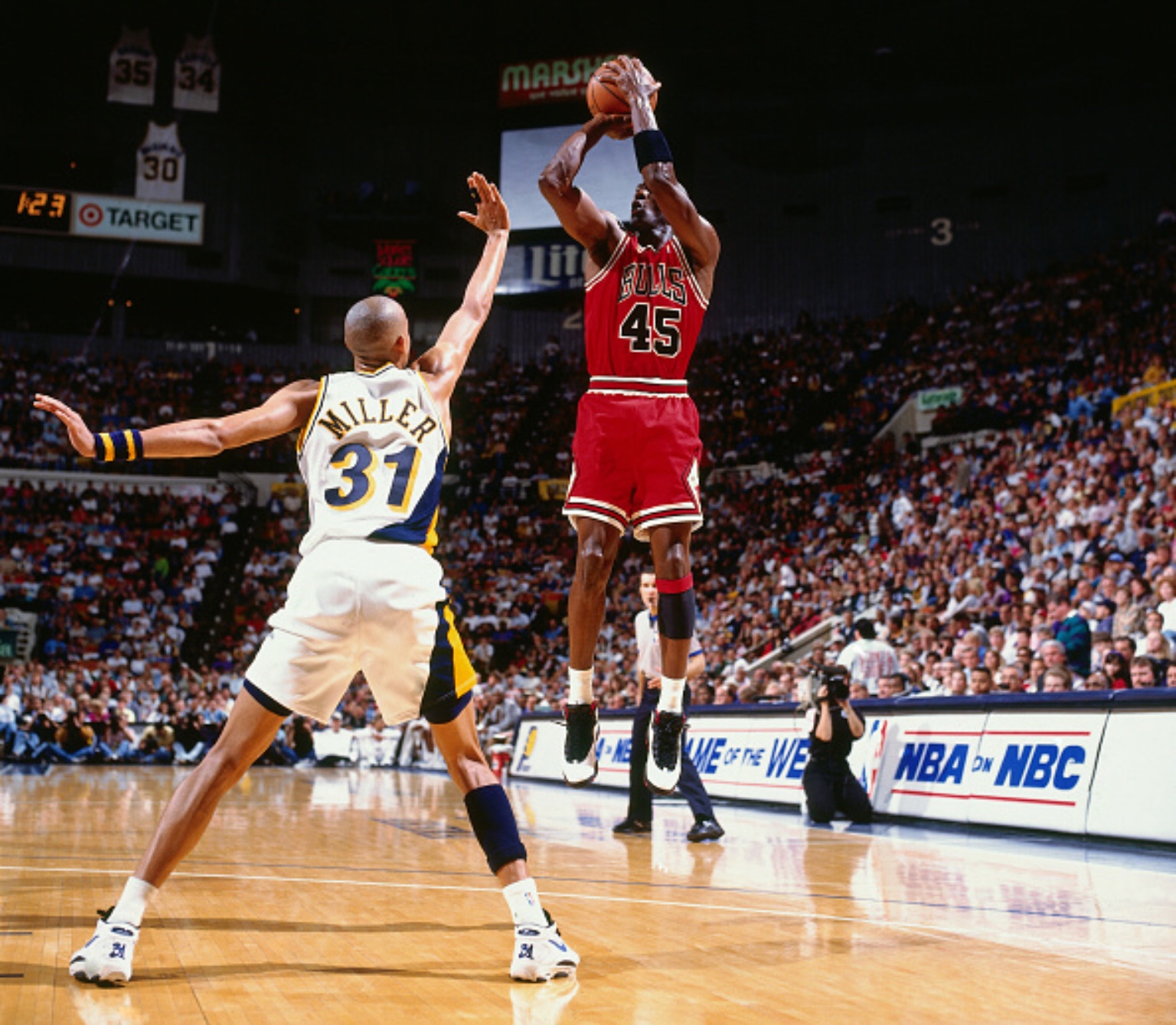
How should we evaluate Michael Jordan’s 1995 season? As a black mark in Jordan’s legacy, proving that he isn’t the perfect player that the media paints him to be. Or should we throw this season away because Jordan was out of the league for an extended period of time since he decided to retire from basketball. Well let’s dive into his season and see if we can have an unbiased point of view from this lost season.
So the first thing we want to look at is how long Jordan was out of the game before he decided to return to the NBA. The last time he played was in June 20th, 1993, when the Bulls won their 3rd straight title. His first game back from his 1st retirement came in March 19th, 1995. That’s a total of 21 months of zero basketball being played at a professional level. There was no training camp and no preseason that he went through. He started in the 2nd half of the season, with the Bulls getting ready for the playoffs. In fact, they were one month away from starting the postseason. So Jordan had a short period of time to get into basketball shape before the playoffs began.
For the 17 total games that he played, he averaged 26.9 ppg on 41.1% shooting, 6.9 rpg, and 5.3 apg. That’s all-star caliber numbers, but that’s not the standard that Jordan is used to playing at. Especially in terms of efficiency. Jordan shot for his career 49.7% from the field, so he was struggling big time with his shot. According to the Chicago Tribune that was written after playing in front of the Chicago fans for the first time, Michael Jordan said this to reporters, “I just can’t turn it on. As much as I want to, I just can’t turn it on.” And that’s how it went for the majority of the regular season for him. In fact, there was only 5 games where he shot over 50% from the field. However there was some games where he showed flashes of his old self.
For example, we have his classic performance against the New York Knicks where he scored 55 points in the Garden. For that game, he shot 56.8% from field. We also have his performance in the prior game, where he had 32 points on 53.8% shooting, but he also made a buzzer-beating shot that just rocked the Atlanta crowd. There’s only a handful players in history that can turn the whole stadium to root for the away team, and Jordan was one of those players. So as far as his regular season play, I mean we don’t want to read too much into his shooting struggles. 21 months is a long time away from the game, and it’s unrealistic to think anyone can just dominate like it’s nothing after being away so long. We can expect the same from Klay Thompson whenever he comes back. He’s one of the greatest shooters of all-time, and he will certainly struggle whenever he gets back to playing for the Warriors after being gone for 2 full seasons.
Now lets talk about his playoff performance. In their first round series against the Charlotte Hornets, Jordan had a big game in game 1. He scored 48 points on 56.3% shooting, along with 9 rebounds, and 8 assists. Chicago won Game 1 despite getting only 27 minutes, three shots and eight points from Scottie Pippen. “Michael bailed us out,” said Phil Jackson after Jordan had scored 20 points in the fourth quarter and overtime. In Game 2 he was almost as masterful with 32 points, seven assists, seven rebounds and one floating, lefthanded, reverse flip of a layup that made it look like the old Jordan was back. For the series, he averaged 32.3 ppg on 49.5% shooting, 6.5 rpg, and 5.8 apg. It was starting to look like Jordan was getting back to his groove and his performance against the Hornets can be described as vintage Jordan.
In the second round against the Orlando Magic, Michael Jordan had an up and down series. This was his average for the series, 31 ppg on 47.7% shooting, 6.5 rpg, 3.7 apg, and 2.5 spg. I mean, does that look like bad numbers to you? So we can’t blame the loss on Jordan being rusty. If we look at all the playoff series from 1995 all the way to his final playoff series in 1998, we can see that his numbers are up to par to how Jordan performed during his 3-peat run. That certainly indicates that Jordan was back to regular season form up to this point. And he had some pretty impressive games throughout the series.
After Nick Anderson foolishly thought it was ok to say to reporters after game 1, “Number 45 doesn’t explode like number 23 used to. Number 23, he could just blow by you. He took off like a space shuttle. Number 45, he revs up, but he doesn’t really take off.” That didn’t sit too well with MJ. So Jordan went for 38 points on 17/30 shooting in game 2 to tie the series at 1 apiece. He followed that up with a 40 point performance in game 3, and he went for 39 points in game 5. Jordan looked explosive in many stretches during these games. There was times where Jordan made these amazing plays that was good enough to be added to his extensive catalog of his incredible highlight reels from his days before he retired. He was also able to bounce back nicely every time he had an off-shotting night. He did that in game 2, and he did the same in game 5, when he shot 53% from the field. Since he was 31 years old during time, he lost a little bit of that hangtime that Jordan is known for, which is what I think Nick Anderson was referring to, but he still had plenty of athleticism. So Jordan showed flashes of greatness throughout this series. But now let’s get to negative aspects of this series.
He had a hard time closing out games. In game 1, Jordan committed two costly turnovers on back to back possessions late in the game. Nick Anderson stole the ball from Jordan that led to a Horace Grant dunk. And then Jordan tried to pass the ball to Scottie Pippen on the baseline, but Pippen couldn’t control the pass and it went out of bounds. The Bulls blew their one-point lead, and they blew a chance to win both games on the road that would have put them in a great position to win the series. Then in game 3, the Bulls were outscored 30-20 in the fourth quarter, and the Bulls also lost their lead that they had going into the fourth quarter. Then in game 6, with their season on the line, the Bulls also couldn’t keep their 8 point lead that they had with less than 3 and a half minutes left in the game. Now the Bulls had a chance to force overtime, but Jordan committed another costly turnover late in the game. He drove into the lane, but as O’Neal popped out, Jordan passed off the ball, and it was lost to the Magic. And that was the end of the Bulls’ season. This is uncharacteristic of Jordan, since he is known as one of the greatest closers of all time. But he just couldn’t get it done. So Jordan played a big part in the Bulls’ playoff defeat.
However, there are a few other factors that we need to consider. Because we can’t put this all on MJ. That’s just wouldn’t be the logical thing to do. First thing we want to look at is the play of Scottie Pippen. He was very inconsistent throughout this series. How about his game 1 performance, when he scored 7 points on 2/11 shooting. Or how about game 5, when Jordan is scoring 40 points in the game, but Pippen contributes to 10 points on 4/13 shooting. It seemed like Jordan was trying to win these games by himself, and it was because he couldn’t rely on his co-star to help consistently when he needed it the most. Pippen just wasn’t playing up to par compared to his MVP-like performance the prior year.
Now lastly, and I think this is the main reason why the Bulls lost this series, and it’s that the Bulls were not yet in championship form. There were still some missing pieces in the puzzle. Most importantly, they were missing that inside presence that Dennis Rodman would later provide in the following years. Without him, the Bulls had to surround Shaq constantly with 2-3 defenders every time he touched the ball. They called it the “Hack Pack”. They had no choice but to do this, since players like Luc Longley, Will Perdue, and Bill Wennington were just bbq chicken for Shaq. So Phil Jackson was going to force someone else to beat them. So that led to a total of 5 different players that averaged a near 15 points per game for the series. Horace Grant, Nick Anderson, and Dennis Scott all had big scoring games throughout the series because their defenders were worried about double-teaming Shaq. Horace Grant was deemed by Shaq as the “world’s greatest role player” after the series. And Jordan called him “their MVP” as well. He averaged an impressive 18.5 ppg on 64.7% from the field.
Dennis Scott had back-to-back 20 point games in games 5 and 6. And Nick Anderson had a 22 point performance in game 3. It was just obvious that the Orlando Magic were a better team than the Bulls. But with the addition of Dennis Rodman, he was good enough to guard Shaq one on one, and the Bulls were able to contain their outside shooting in that series in 1996. In that conference finals matchup, Nick Anderson and Dennis Scott both averaged less than 10 ppg, and they shot very poorly from the field. Anderson averaged 31% and Scott averaged 26% for that series. And that’s also thanks to the Bulls deciding to make Ron Harper a key piece to their team, and they needed to get rid of BJ Armstrong to do so. However by doing that, they created one of the greatest defensive backcourts of all-time. The length and versatility of Ron Harper, Jordan, and Pippen allowed them to switch off and defend post players without resorting to double-teaming. So with the improvements that they made on their roster, the Magic were no match for the Bulls in ’96. But in ’95, the Bulls had to rely on Jordan too much, and they had no players that could possibly contend against Shaq. With all the great shooters that the Magic surrounded him with, they just had the perfect game plan to defeat the Bulls. Although if the Bulls had just a few breaks go their way, they could have still possibly won the series.
So in conclusion, the Magic won fair and square. They were the better team. Michael Jordan should be excused for his low regular season numbers, but not for his play in the playoffs. He didn’t close out well in 3 of their losses to the Magic, but the main reason that the Bulls lost was their glaring weakness in their interior defense that allowed the Magic to exploit it. Jordan played good in this series, so I wouldn’t exactly call this a black mark in his legacy. But we shouldn’t pretend like this series never happened like some do.
To enjoy the audio version of this article, click on the link here
 Christian's NBA Blog