Ahhh… the year 2007. This was the year we had so many high hopes and was completely let down. Like take for instance the blockbuster movies that came out. Spiderman 3 came out in that summer. We were supposed to see Spiderman take on Venom, except he also took on Sandman and the Green Goblin. I was 14 years old at that time watching the pirata version, and I was thinking, this seems a little too…… corny. Dare I say Batman and Robinesque! Jerry Seinfeld made his first and only animation movie, the Bee Movie, and that one also missed the mark. But at least it gave us countless memes a decade later.
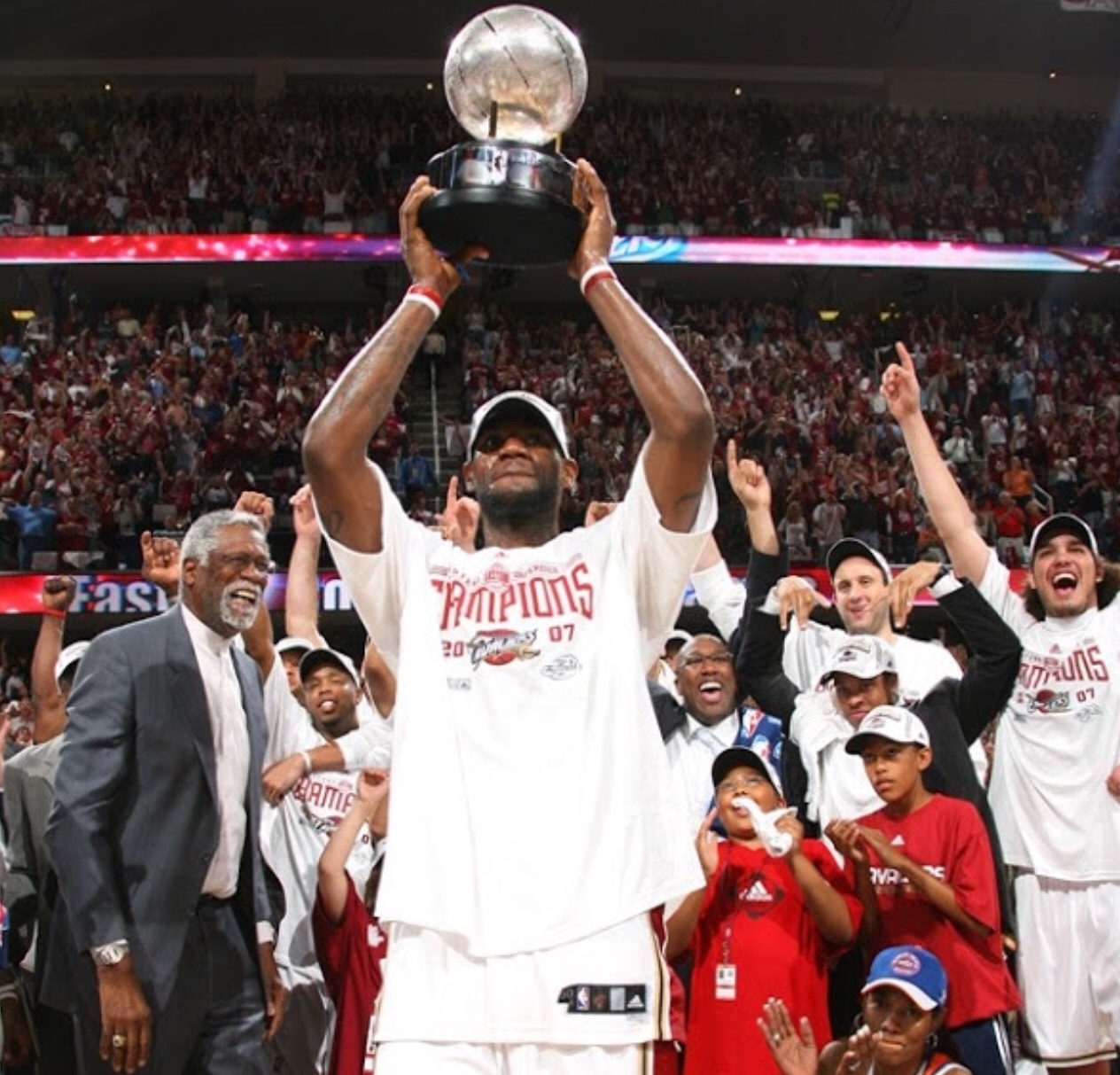
The NBA 2006-07 season was no exception to the disappointment we experienced. The 82 game regular season usually drags, but this particular season was very tough for NBA fans to go through. I guess we had a couple of nice buzzer beaters by Agent Zero, Kobe gave us a month of crazy scoring games, and we had the brawl in Madison Square Garden where Carmelo suckered punch Mardy Collins and then proceeded to back pedal all the way to the locker room. Dirk Nowitzki was the MVP after giving us a year where his per game numbers was matched by Elton Brand. The playoffs however gave us some classic moments. We had the “We Believe” Warriors, the butt-shove of Robert Horry, and the coming-out party of LeBron James in game 5 of the eastern conference finals. This is where the legend began!
When discussing the greatness of LeBron James, a lot of people like to bring up what he accomplished in the 2006-07 season. There is no debating that his ability to lead his team to their first finals appearance in franchise history was impressive. It is certainly something worthy to bring up when discussing his legacy. However one thing that I hear a lot of people exaggerate about is when they say that the Cleveland Cavaliers had no business even making it to the finals that season. I simply don’t believe there is much merit to make such an egregious statement. And when looking at the context of that season, we can see the other side of that story.
The first thing we want to look at is the type of success that the Cavaliers had that season. They finished with a 50-32 season record, which was good enough for the 2nd best record in the eastern conference. One thing that they excelled at was defense. They allowed their opponents to 92.9 points per game, which was the 5th best mark in the league. They were also 4th in defensive rating that season. To put that in perspective, the Detroit Pistons, who were famously known at this time for their defense, allowed their opponents to 91.8 points per game, and they were 7th in defensive rating that season. We’re talking about a top 5 defensive team. They were not much help to LeBron in the offensive end, but they held their own defensively.
Yes it’s true that the Cavaliers were a team that had little to no talent, but the same thing can be said about 14 of the other 15 teams of the eastern conference. This was the starting five of the 3rd seed of the east, the Chicago Bulls: Kirk Hinrich, Ben Gordon, Luol Deng, Andres Nocioni, Ben Wallace. A respectable team, but let’s not act like they were the top team to challenge the Pistons. The Toronto Raptors were next in line and this was their starting five: Anthony Parker, TJ Ford, Joey Garbajosa, Chris Bosh, and Rasho Nesterovic. Nothing impressive there either. Every other team after that finished with 44 wins or less. What LeBron had was the same problem that Dwayne Wade, Chris Bosh, Dwight Howard, and Vince Carter/Jason Kidd was all facing with. A lack of help. The fact is that LeBron was just better individually than any other player in the eastern conference. And for the 2006-07 season, that was enough to get it done.
A counter-argument that a lot people will bring up is how the Pistons were a much more superior team than Cavaliers. They won a championship in 2004, they were one game away in 2005 in repeating as champions, and they made it to the conference finals in 2006. In fact, the Cavaliers only won one time out of the four games against the Pistons in their regular season matchup that season.
However one major difference that weakened the Pistons from the previous years was that they lost Ben Wallace in free-agency that offseason. They replaced him with a 33 year old Chris Webber in a midseason signing, and they also added Nazr Muhammed. Ian Thomsen said this about the difference in the Detroit Pistons in a 2007 SI article, “As a strict man-to-man team last year, Detroit counted on Ben Wallace to defend the rim and offset its deficiencies elsewhere. Since Wallace’s departure to Chicago, however, the Pistons have been refining a variety of zones, traps and rotations that returned the team to the top six in the league defensively.” They was able to adjust well in the regular season, however the Pistons missed the presence of Ben Wallace in the conference finals. Jack McCallum said this in a 2007 SI article after the Cavaliers defeated the Pistons in the eastern conference finals, “How to explain Game 5 in basketball terms? Certainly Detroit was complicit. Known for their ability to change defenses on the fly, the Pistons seemed confused about what scheme they were playing. Sometimes, they had two defenders on James and neither stopped him; sometimes, after he (almost inevitably) sped by a single perimeter defender, no one picked him up. James came close to being a one-man team: The Cavs had only one assist in the game’s final 22 minutes and just 13 for the game.” It wouldn’t be far fetched to say that Ben Wallace could have played a part in containing LeBron James in that infamous game 5.
Another simple stat that we can put to show how much the Pistons missed the presence of Big Ben was that the Pistons went from 64 wins the prior year to 53 wins in 2007.
The Pistons did however still had one of the game’s best offensive trios of Chauncey Billups, Richard Hamilton, and Tayshaun Prince. Their bench wasn’t exactly deep, but all the league experts were picking the Pistons to come out of the east. They saw the Cavaliers as a one-man show, and they had much more confidence in the title experience of the Pistons. They kept comparing LeBron to what Michael Jordan had to go through early in his career against the Bad Boy Pistons. They thought he had to go through more failure like Jordan did to overcome the Pistons. They were wrong about LeBron, and they were wrong for even comparing this version of the Pistons to the legendary Pistons team of the 80’s. LeBron showed a lot of maturity after he received criticism for passing up the game-winning shot in game 2, and the Cavaliers did a good job making Tayshaun Prince a non-factor offensively for this series. The Pistons made their starters log a lot minutes in their playoff run due to their lack of depth, and they ultimately ran out of gas in that deciding game 6.
Speaking of game 6, what happened in that game showed that LeBron’s teammates were more than capable of stepping up. After LeBron’s performance in game 5, the Pistons vowed to not let LeBron come out with an encore performance. They were going to dare someone else to come up big. They did a good job in containing LeBron, as he had only 20 points on 3/11 shooting. However the Cavaliers got a huge game from Daniel Gibson. He ended up with 31 points, including a 19 point 4th quarter to blow the game wide open. That was huge statement in the Cavaliers biggest franchise victory up to that point. I wouldn’t quite describe them as bums.
Let’s not get it confused though, I’m in no way trying to discredit what LeBron James accomplished in that series, and especially in that game. Jack McCallum continues saying in his article, “But the only real explanation is that the 6’8″, 240-pound James unleashed everything that was already in his arsenal. He can break down defenses off the dribble, and if he gets near the basket, he will power-dunk on anyone’s cabeza. He is a threat in the open floor. (…) He can shoot standstill jumpers from the perimeter and absurd fadeaways that are unblockable. He has a decent midrange game — witness his 16-footer from the right wing with the shot clock winding down in the last minute that proved to be the key basket in Game 3. He can post up and take advantage of his superior size at the small forward position, and he can nail jumpers off curls and pin-downs (though he does need to improve in that area). And most of all he is a willing and able passer, irrefutably in the league of Magic Johnson and Larry Bird.”
Bill Simmons also said this in a 2007 ESPN article, “Physically, LeBron overpowered the Pistons. This was like watching a light-heavyweight battling a middleweight for eight rounds and suddenly realizing, “Wait, I have 15 pounds on this guy,” then whipping the poor guy into a corner and destroying him with body punches. The enduring moment was LeBron flying down the middle for a Dr. J retro dunk and Tayshaun Prince ducking for cover like someone reacting to a fly-by from a fighter jet. The Pistons wanted no part of him. They were completely dominated. They didn’t knock him down, they didn’t jump in front of him for a charge … hell, they were so shell-shocked by what was happening, they didn’t even realize they should be throwing two guys at him.”
One game can impact an entire series, and LeBron did exactly that. The Pistons and Cavaliers took care of business in their home floor, but LeBron gave a classic playoff performance in that huge game 5.
Later what happened in the finals against the San Antonio Spurs showed us that they were in a whole other league compared to the Cavaliers. It wasn’t really close. The NBA was facing a problem. Bill Simmons said this in a 2007 ESPN article,“Once the league’s reckless (repeat: reckless) expansion pushed the number of teams past the mid-20s, it became too easy for one conference to be stacked with elite teams. David Stern has argued multiple times that this stuff evens out over time, but clearly, that’s not true. We’ve had much better teams in the West for nearly a full decade; in eight of the past 10 seasons, the best two teams played before the Finals, and in four of those seasons, they played before the conference finals. Um … that’s not a major flaw in the system?” That’s what we saw for the first seven years of the 2000’s decade, and it didn’t take long for things to change. In fact it changed in draft night in 2007, when Kevin Garnett and Ray Allen joined the Boston Celtics.
It was clear that the Cleveland Cavaliers were not one of the top teams in the league. The Detroit Pistons were a great team, but they were beatable. LeBron showed us why he is so great, he one of the best we’ve ever seen in getting the most out of the little talent that he is surrounded by. There is no debate about that, this was simply all about timing. The Cavaliers remained a top team in the east for the next 3 years, but there was no powerhouse that stood in its way to play the role of the Bad Boy Pistons for LeBron until 2008. For the year 2007, the eastern conference title was up for grabs for anyone.
 Christian's NBA Blog